4.3/5

Welcome to the Albret Tourist Office

Marguerite de Valois

Queen Margot (1553–1615)

The life of Marguerite de Valois, sister of the last three Valois kings of France, Francis II, Charles IX, and Henry III, became legendary inthe 19thcentury thanks to Alexandre Dumas' novelLa Reine Margot.


A refined, cultured woman of striking beauty, according to Brantôme, one of her many admirers, she reluctantly married Henri of Navarre in 1572. Their wedding, celebrated on the steps of Notre-Dame Cathedral in Paris, was followed six days later by the St. Bartholomew's Day massacre, which earned their union the nickname "noces vermeilles" (scarlet wedding)...

François Clouet, Portrait of Marguerite de Valois, 1572 - © Musée Crozatier du Puy-en-Velay

Margot's courtyard in Nérac

Marguerite de Valois's first stay in Nérac took place from July 28 to August1, 1565, as part of Charles IX's Grand Tour of France between 1564 and 1566.


After her marriage to Henri de Navarre, her husband, who had come to live in Nérac, demanded the return of his wife, which he received on December 15, 1578. Until 1585, they formed a veritable royal court which, according to Margot'sMemoirs, "was so beautiful and pleasant that we did not envy that of France."


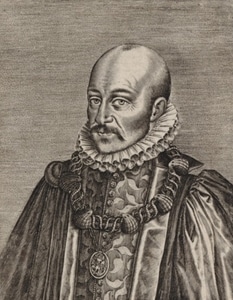
Following in the footsteps of Marguerite d'Angoulême, Margot turned Nérac into a veritable literary academy. She welcomed scholars and intellectuals such as Guy du Faur de Pibrac, a magistrate and poet who accompanied her upon her arrival in 1578; the Protestant historian and poet Agrippa d'Aubigné, comrade-in-arms of Henri de Navarre; Guillaume du Bartas, writer and poet; Michel de Montaigne, author ofthe Essays and soon to be mayor of Bordeaux, engaged in passionate literary exchanges with Queen Margot.

Thomas de Leu, Portrait of Michel de Montaigne, print, 1608 – © Bibliothèque Nationale de France in Paris

Nérac, a haven of peace

During this troubled period of the Wars of Religion, Marguerite de Valois succeeded in making Nérac a refined court and a haven of peace by granting the town a unique privilege, "the magic circle." She persuaded her brother, King Henry III, to declare Nérac a neutral town and to prohibit any fighting within a radius of three leagues around the town, a provision that was unique at the time.

The 3,000-step walkway

Marguerite de Valois, who describes in hermemoirsa period of "happiness in Gascony," spent most of her time in Nérac. She left her mark by shaping the Parc de la Garenne as we know it today. Queen Margot extended the Garenne beyond the route created by Antoine de Bourbon with a 3,000-step walkway starting at the Saint-Jean fountain and ending at the village of Nazareth. The park became a place of leisure and recreation, featuring an aviary and caged animals, including a bear, a wolf, monkeys, and even a lioness!


Queen Margot, who is said to have truly loved this walk, took it regularly to visit a small chapel built by Henri de Navarre in 1579. Located near the Saint-Jean fountain, it allowed his wife and Catholics to attend services in the only place of Catholic worship in Nérac.

Allée des 3000 pas (3,000-step path) in the Parc de la Garenne in Nérac – © OTVA

Nérac, capital of pleasures

In Nérac, Marguerite de Valois combined literary, religious, and philosophical pursuits with amorous pleasures. The court of Nérac thus became famous for the royal couple's adventures. Henri de Navarre seduced some of his wife's 33 ladies-in-waiting, while Margot did the same by seducing her husband's companions. This reputation even inspired the famous English writer Shakespeare, who used the court of Nérac under Henri de Navarre and Margot as the historical backdrop for his comedy "Love's Labour's Lost."

Portraits of Henry of Navarre and Marguerite de Valois, circa 1572, miniature from Catherine de Medici's book of hours - © Bibliothèque nationale de France in Paris

Exile in Auvergne

Unfortunately, romantic and political intrigues caused discord within the royal couple. Their final breakup came in 1585: Margot left Nérac for Agen, where she joined the Catholic League. Rejected by both her husband, who considered her infertile, and her family, who deemed her behavior scandalous, she was forced to live in exile for many years at the Château d'Usson in Auvergne. In 1589, when her husband succeeded his brother Henri III to the throne of France, Marguerite de Valois indirectly became Queen of France.


Henri IV then resumed contact with his wife because he needed her support to remarry and finally have a legitimate heir. The papal bull annulling the marriage was issued in 1599. Margot obtained from the king her return to Paris and to the French court, as well as substantial financial compensation that allowed her to live peacefully until her death in 1615.

Henri IV Castle Museum
Moulin des Tours

Guided tours in February

From Tuesday, February 10 to Thursday, February 19,

The Albret Tourist Office invites you to follow its guides on a journey of discovery:


of the Moulin des Tours and

of the Henri IV Castle Museum