The bronze statue of the good King Henry IV, located on Place du Général Leclerc in
Nérac was added to the supplementary inventory of Historic Monuments in 1990.
A work from the Restoration period
In 1816, Philippe Digeon de Monteton, Count of Digeon and deputy of Lot-et-Garonne, wanted to impress the new king, Louis XVIII. He offered to pay for a statue of Henry IV, founder of the Bourbon dynasty and emblem of the city of Albret, to be erected in the town of Nérac. The Restoration, which relied on the tutelary figure of the first Bourbon sovereign as a symbol of national reconciliation and legitimate monarchy, could only approve this project.
The sculptor Nicolas Raggi
The Count of Digeon placed an order with sculptor Nicolas Raggi. Born in Carrara, Italy, the world capital of marble, Raggi created a bronze statue measuring 3.20 meters in height. His work was exhibited at the Paris Salon in 1819, where it won a gold medal, and went on to take pride of place in the courtyard of the Louvre. He even created a marble version based on the original for Pau in 1843 and a plaster version that can be found in the conference room of the Palais Bourbon in Paris.
Henry the Peacemaker
Standing firmly on his feet, his helmet topped with a white plume at its base, the king in armor rests his left hand on his sword, symbol of his power and royal authority. His outstretched right hand symbolizes a gesture of clemency and reconciliation: it is the image of the peacemaking king who will unite Catholic and Protestant France after the troubled years of the Wars of Religion.
The inscriptions on the base
On the base of the statue, designed by the Count of Digeon along with the gate, there are several inscriptions. The first, in Gascon, located on the front of the base, recalls the glorious memory left by the good King Henry in the city of Nérac:
To Nosté Henric To our Henri
A second inscription, also in Gascon but on the right side, requires a more in-depth knowledge of the language. It evokes the image of a popular and benevolent king, close to his people and concerned about their daily lives.
Brabés Gascous / A moun amou bous-aous qué diouetz crézé / Benguetz! Benguetez! / Qu’ey plasé d’étzé bézé / Approuchatz bous Braves Gascons / My love, you must all believe / Come, come! I am pleased to see you / Come closer!
On the back, there are two other inscriptions. The first, in Latin, is said to have been written by Louis XVIII himself:
Alumno Mox Patri Nostro Henri IV To our child, who became our father Henri IV
The last one in French is a letter of thanks from the town of Nérac to the Count of Digeon:
This monument, which the town of Nérac owes to the generosity of the Count of Dijon, was inaugurated on May 3, 1829. It was moved to this square on July 24, 1872.
Arrival in Nérac
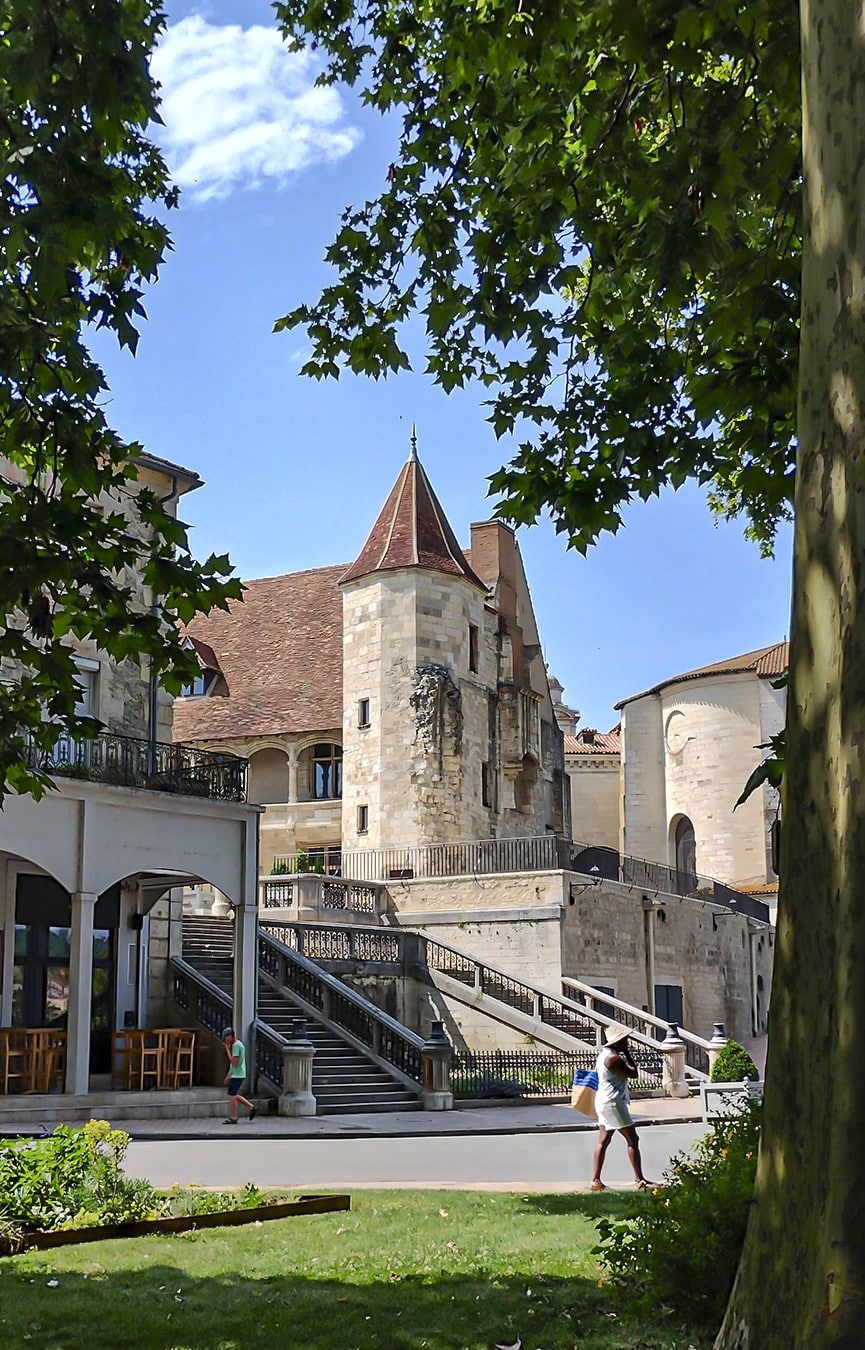
In 1823, the statue finally arrived in Nérac, but its location became a source of contention. For nearly six years, the donor and the municipality disagreed on where to place it, and the statue remained locked in a wooden crate... It must be said that the Château de Nérac was in a sorry state at the time. The Count of Digeon even considered the castle and its surroundings unworthy of receiving the statue. In 1829, a consensus was finally reached. The statue was finally installed in front of the Château de Nérac, the main residence of Henry IV before he embraced his destiny as King of France, in accordance with the new wishes of the Count of Digeon, who wanted to create a square there... which was never built due to a lack of funding.
Its inauguration on May 3, 1829, gave rise to three days of festivities in the city, on the Baïse River, and at La Garenne. The Société Académique d'Agen also organized a poetry competition, which was won by the Occitan poet Jasmin. In 1855, the heirs of the Count of Digeon opposed the relocation of the monument to Place du Marché (now Place du Général de Gaulle).
Moving to Fallières
After Viollet le Duc abandoned his plans to restore the Château de Nérac, Armand Fallières wanted to make a smaller change to the site in 1872 by building monumental staircases facing the Pont-Neuf. The statue of Henry IV was temporarily moved while the work was carried out. There was some hesitation over the Place du Temple (now Place Aristide Briand), which was ultimately deemed too small, and the Place de Normandie (now Place du Général Leclerc) was chosen instead. Its size, central location, and high footfall made it seem like the ideal temporary home.
By moving the statue, Armand Fallières skillfully began his term as mayor by reviving the myth of Henry IV, whom the Legitimists had made a symbol of the restoration of the monarchy in the early 19th century.
A new project?
In 2014, the Friends of Old Nérac sent a letter to the Nérac Town Hall proposing that the statue be returned to its original location in the castle courtyard.
"This statue of the only popular king symbolizes our town. It is one of the two most beautiful statues in France." Excerpt from a letter from the Friends of Old Nérac to the Town Hall of Nérac
For the Friends of Old Nérac, two factors prompted them to reconsider the situation and envisage a return to the castle square: the restoration of the castle with the installation of a museum in 1934 and the removal of the village hall on the esplanade meant that the castle and its courtyard were finally worthy of receiving the statue.
" On the other hand, the emergence and development of motor traffic in the 20th century, with the installation of traffic lights at the Place du Général Leclerc intersection, obscured the view of the statue, both for motorists, whose eyes were fixed on the lights, and for pedestrians, who were hindered by traffic and had no space to stand back and admire the 3.20-meter colossus."
The return of the statue of Henry IV to the top of the monumental staircase and at the foot of his castle would become Nérac's best calling card.
Bibliography
– Friends of Old Nérac, "Si Nérac m’était photo conté…" (If Nérac were told through photos...), Éditions d’Albret, 2005, pp. 60–61.
– Bronze statue of Henry IV, entry no. PA00084284, Mérimée database, French Ministry of Culture
Discover the Hôtel Henri IV, a charming 3-star hotel located in the heart of Nérac, perfect for a weekend getaway, a stopover during your travels, or a relaxing stay.
Fancy a getaway to Albret? Discover the Hôtel Henri IV, a charming 3-star hotel located in the heart of Nérac—perfect for a weekend getaway, a stopover during your travels, or a relaxing stay.