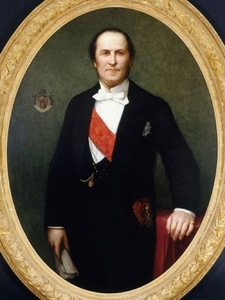
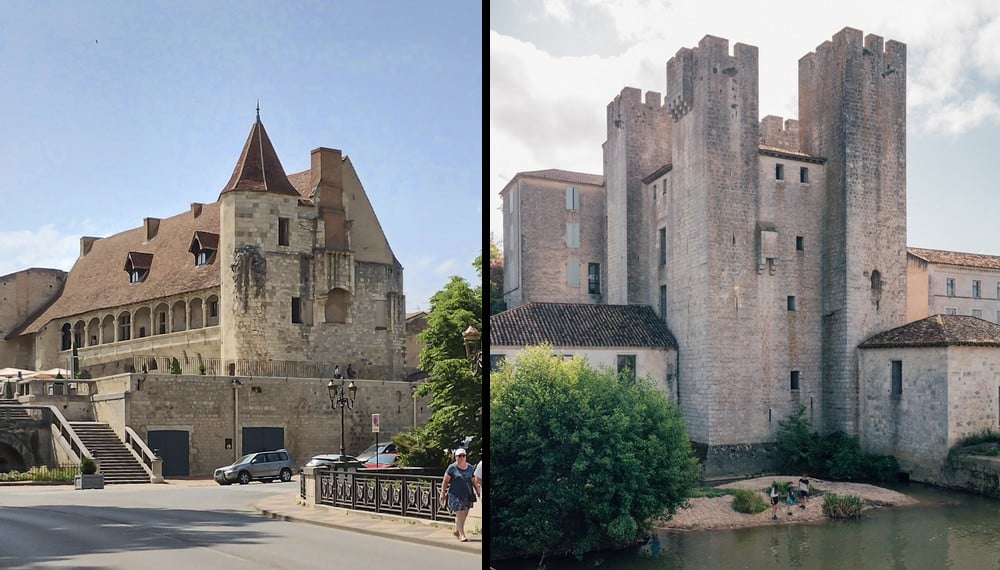
Baron Haussman, a young sub-prefect in Nérac (1809–1891)
Famous for his work in transforming Paris, Georges-Eugène Haussmann had previously enjoyed a brilliant career in the prefectural administration. It was there that he discovered rural France and shaped his political education.
Born in Paris, Eugène Haussmann came from a Protestant family that embraced the Bonapartist cause. He received a solid education and, at the age of 11, entered the Collège Henri IV, now the Lycée Condorcet, where he passed his baccalaureate with flying colors. He then enrolled in law school and simultaneously took courses at the Sorbonne and the Collège de France, taught by renowned philosophers and scientists.
At the age of 21, he took part in the events of the July Revolution of 1830 and was rewarded by Louis-Philippe, King of the French, who was the father of his high school friend, the future Duke of Orleans.
Apprenticeships in the provinces: Vienne and Haute-Loire
His excellent relations with those in power enabled him to find a position in the royal administration: in 1831, he was appointed secretary general to the prefect of Vienne, where he managed administrative affairs.
In 1832, he became sub-prefect of Haute-Loire in Yssingeaux. To open up his district and combat illiteracy, he advocated the development of trade through the creation of transport links and the development of public education. Eager to prove himself, he requested a transfer and became sub-prefect of Lot-et-Garonne in Nérac in 1832.
Seven years of loyal service in Nérac
Upon his arrival in Nérac, Georges-Eugène Haussmann was greeted with suspicion by both liberal Protestants, for political reasons, and Catholics, for religious reasons. But through his actions and measures in the district of Nérac, Haussmann quickly won people over.
His proximity to the Protestant community enabled him to meet Pastor Henri de Laharpe, who introduced him to his sister, Octavie, the future Madame Haussmann. Through this marriage, Haussmann became allied with a family of wealthy Bordeaux merchants, allowing him to enter high society.
Haussmann began by touring the country to assess the tasks at hand. He seemed disappointed by the infrastructure in his district, which lacked modern transportation routes.
Aided by the 1836 law on local roads, which required municipalities to levy taxes for road maintenance, Haussmann brought the villages of Albret closer together. To this end, he had roads built from Agen to Nérac, Nérac to Lavardac, and Lavardac to Casteljaloux, reminiscent of the long, wide avenues built by Haussmann in Paris.
To this end, he is building a bridge in Nérac, the Pont-Neuf, which will span the Baïse River and connect Nérac to Agen.
Haussmann also made the education of the children of Nérac a priority. With the help of the Guizot Law of 1833 on primary education, he provided all the municipalities in the district of Nérac with a school from the start of the 1836 school year.
His determination and dedication earned him the Legion of Honor in 1837, but also aroused the jealousy and complaints of the Prefect of Lot-et-Garonne, Mr. Brun. This man did not appreciate the visits of the famous writer George Sand and the Duke of Orleans to the sub-prefect of Nérac instead of the prefect of Agen. The effects of this resentment were immediate and disgrace was pronounced: Haussmann, who had requested a new transfer and promotion, found himself appointed in 1839 to a sub-prefecture in Ariège, in Saint-Girons, where he remained until 1841.
The architect of modern Paris
He then moved closer to his in-laws when he was appointed sub-prefect in Blaye, Gironde, until 1848.
From simple positions in the prefectural administration, the fate of Georges-Eugène Haussmann, a staunch Bonapartist, changed dramatically with the election of Napoleon Bonaparte as President of the Republic in 1848. He then took on a number of positions of responsibility: prefect of Var, Yonne, Gironde, and Seine under the Second Empire. Napoleon III wanted to transform and modernize the capital to make Paris the showcase of the Empire. Haussmann was the chief architect of this project, and his work has gone down in history as Haussmannian architecture.